Not everyone was a big loser during last week’s crypto flash-crash.
Over the previous week, President Trump’s surprise announcement of 100% tariffs on Chinese imports triggered a violent crypto sell-off that wiped out more than $19 billion in leveraged positions. Two traders, however, timed the move perfectly, turning the market chaos into a $160 million profit.
Bitcoin (BTC) plunged 12% within hours, setting off a chain of liquidations that accelerated the downturn. Smaller tokens fell as much as 80%, deepening the rout. Data provider CoinGlass noted that the actual liquidation total could be even higher, as several platforms still conceal full liquidation data.
Sudden downturn leads to $160 million windfall
This crash revealed how deeply leveraged parts of the market remained. The downturn, tied to macro policy rather than internal crypto dynamics, revealed how sensitive digital assets have become to geopolitical actions.
In the final moments before Trump’s tariff announcement, two accounts on Hyperliquid placed large bets that Bitcoin and Ethereum (ETH) would collapse.
Below are the clearest details available on the two winning accounts, gathered from on-chain data and trading reports:
- Platform & timing: Executed on Hyperliquid just before Trump’s tariff announcement.
- Position size: Over $1B in combined BTC and ETH shorts, per on-chain data.
- Account funding: Each wallet reportedly started with around $2.3M–$2.5M in collateral.
- Profits: One earned $72.3M from ETH shorts; the other made $92.8M from BTC, nearly $160M in total.
The last of these shorts was opened just a minute before the tariff announcement, sparking speculation about insider knowledge.
Yet, as several analysts pointed out, the timing also coincided with Beijing’s decision to restrict rare-earth mineral exports, which likely foreshadowed the U.S. response. The traders’ identities remain unknown.
Major coin losses during the crash:
- Bitcoin (BTC): Down 12%, sparking mass long liquidations.
- Ethereum (ETH): Slid 15% amid heavy margin calls.
- Solana (SOL): Plunged nearly 50% at peak volatility.
- XRP & Avalanche (AVAX): Dropped 30%–60% on thin liquidity.
- Altcoins: Many crashed 60%–80%, exposing fragile leverage.
Most liquidations occurred on derivatives giants Binance, OKX, and Bybit, where forced futures closures drained liquidity and accelerated the slide. Open interest in Bitcoin futures fell more than 30%, returning leverage metrics to levels last seen in May. Funding rates flipped sharply negative, marking a shift from speculative optimism to caution.
Is there hope for crypto market rebounding from the fall?
By October 13, Bitcoin had climbed back above $114,000, gaining nearly 12% from its weekend slump, but was currently around $111,395. Ethereum also steadied around $4,100, helped by roughly $420 million in new spot Bitcoin ETF inflows that calmed the market a bit.
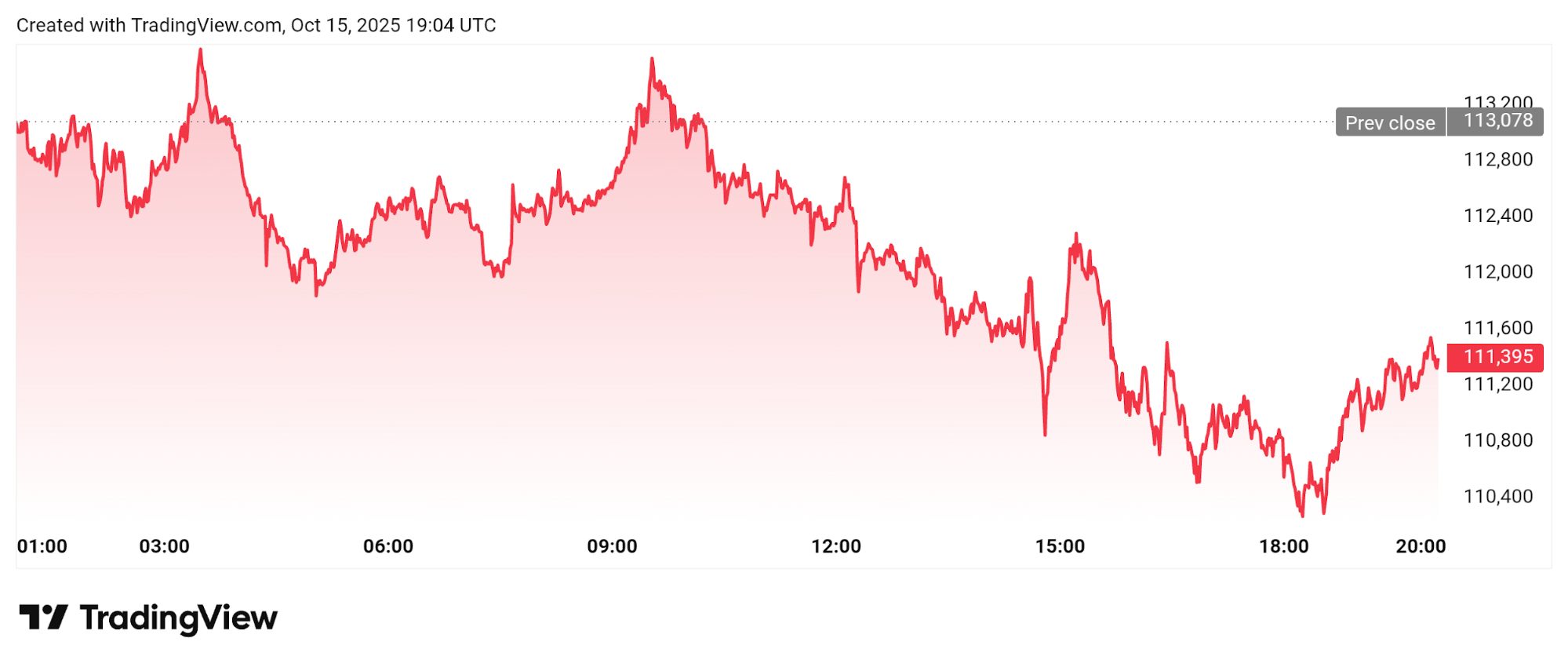
Bitcoin price. Source: TradingView
Solana (SOL) drifted back toward the mid-$160s, though trading remained light. XRP held near $0.52 as buyers slowly stepped in, while Avalanche (AVAX) hovered around $38.
Altcoins have found their footing, but with thinner volumes as major desks and liquidity providers return cautiously. Even so, Bitcoin’s implied volatility stays above 50%, suggesting traders aren’t ready to pile in just yet.
This latest tariff-fueled drop shows that crypto no longer moves in isolation; it now dances to the rhythm of global policy and market liquidity.