The ability to earn yield and unmatched liquidity in decentralized finance might give Ethereum the edge for corporate treasuries.
Ethereum is emerging as the stronger contender among major digital assets as corporate treasuries look to balance holdings under tighter market conditions, according to new research from Standard Chartered.
The bank’s analysts said Ethereum’s proof-of-stake model and staking rewards provide structural advantages that could allow it to outpace both Bitcoin and Solana as the sector matures.
Geoffrey Kendrick, Standard Chartered’s global head of digital assets research, wrote in Monday’s report that Ethereum-based treasuries are already more firmly established than their Bitcoin counterparts and stand to benefit from steadier institutional demand.
Here are some of the key figures Standard Chartered highlights to back its thesis:
- DATs currently account for about 4% of Bitcoin, 3.1% of Ethereum, and 0.8% of Solana.
- ETH treasuries have purchased roughly 3.1% of circulating ETH since June, showing aggressive accumulation.
- BitMine Immersion reports over 2.15 million ETH on its books, valued at more than $10.7 billion.
- U.S. spot ETH ETFs collectively hold 6.69 million ETH, with BlackRock’s ETHA leading at $12.7 billion in assets.
With valuations for publicly listed companies holding crypto under pressure, Kendrick said Ethereum’s yield-generating design positions it as a stronger treasury asset compared with Bitcoin’s non-yielding structure. This dynamic, he added, could make ETH the preferred balance-sheet choice as market stress grows.
Digital-asset treasuries (DATs) rely on trading above their net asset value, known as mNAV, to keep raising capital for purchases. But in recent weeks, many have fallen below 1, limiting their buying power and drawing scrutiny to the sector.
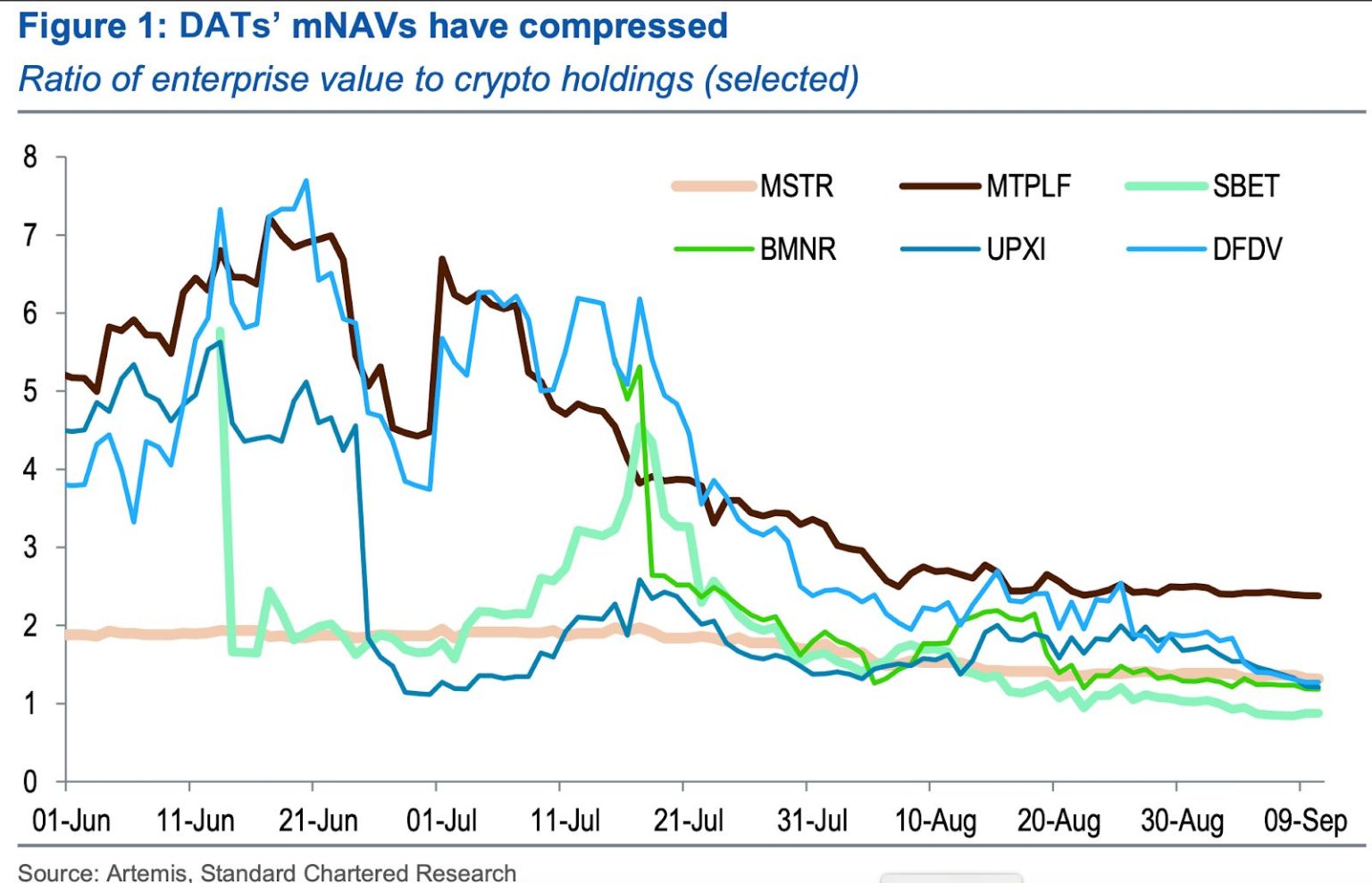
Source: Standard Chartered Research
Standard Chartered expects a shakeout, with outcomes hinging on three factors: cheap funding, scale that attracts liquidity, and the ability to earn staking yield.
Additionally, the bank flagged market saturation in BTC-focused models. Strategy’s success drew nearly 90 peers, now holding more than 150,000 BTC, six times early-year levels, setting up conditions that favor consolidation over new spot demand.
The report suggested weaker treasuries may be absorbed by larger players if discounts persist, shifting coins within the cohort rather than driving new market buying.
Meanwhile, ETH treasuries keep expanding, with some firms restoring net asset value (NAV) near parity, making them attractive for investors seeking structured ETH exposure.
Do ETH and BTC prices back up Standard Chartered’s call?
Ethereum trades near $4,499, down 0.40% in 24 hours. Its $4,425–$4,536 range shows volatility as markets weigh staking-yield treasuries.
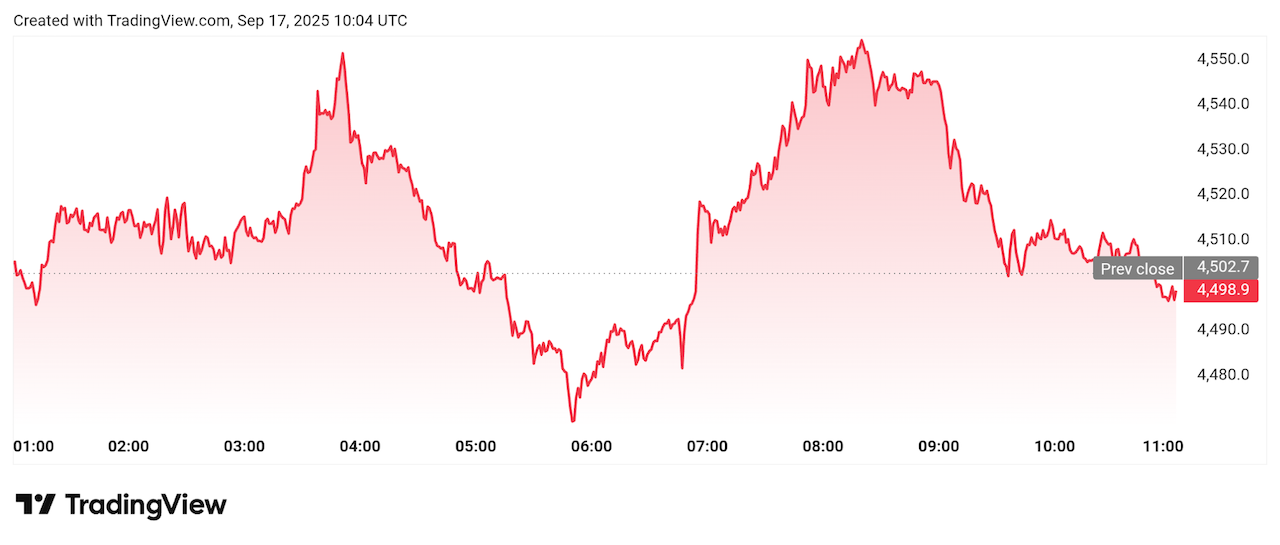
Ethereum price. Source: TradingView.
Bitcoin, meanwhile, is steady near $116,734 after ranging between $116,000 and $117,500.
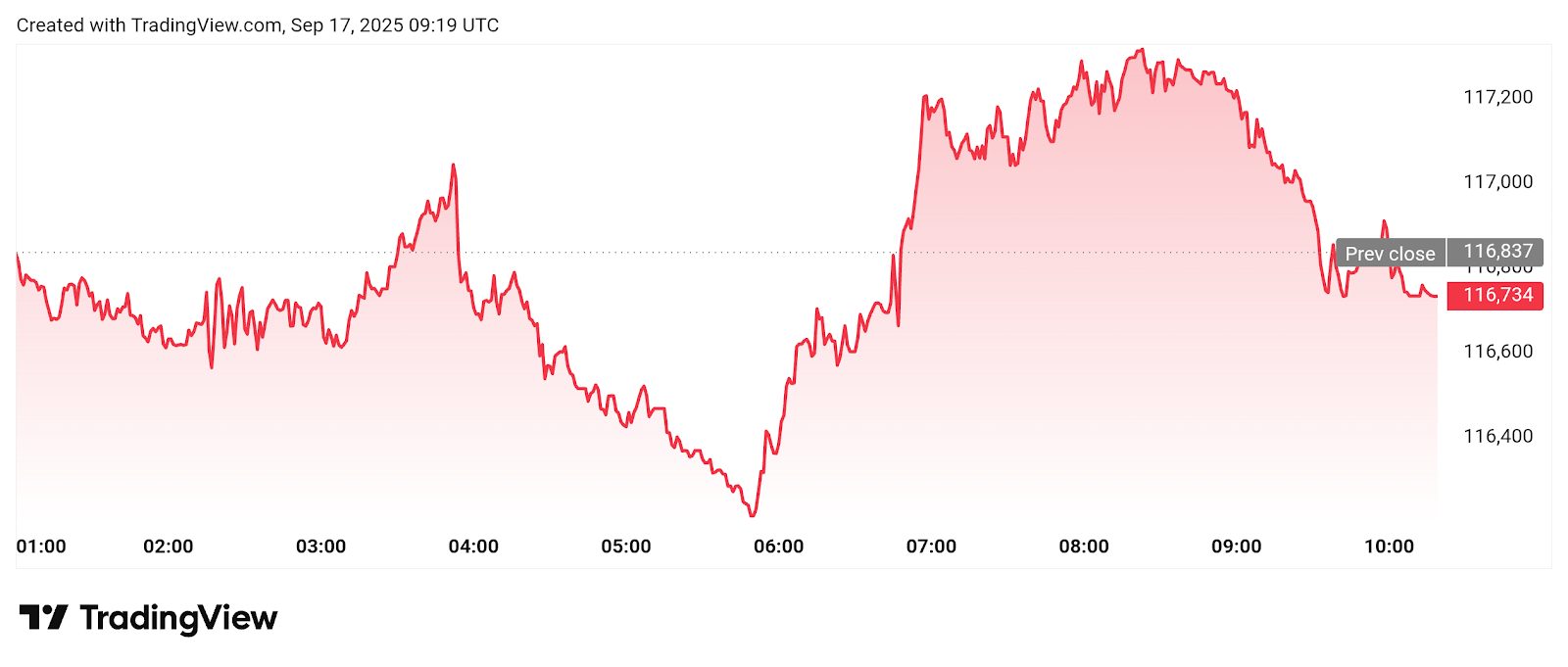
Bitcoin price. Source: TradingView
The muted action reflects Standard Chartered’s view that BTC treasuries are mainly recycling coins rather than adding new demand, making ETH appear the steadier asset. Additionally, their already substantial token allocations mean any shift in treasury behavior carries outsized influence on broader price dynamics.