Can anyone match the speed of Solana?
The cryptocurrency world lit up this week as Solana (SOL) shattered a new benchmark in blockchain performance, becoming the first major chain to surpass 100,000 transactions per second (TPS) on its mainnet, as per Blockdata.
The Sunday record-setting block, processed by validator “Cavey Cool,” logged 43,016 successful transactions and 50 failures, cumulatively pushing Solana’s peak output to 107,540 TPS.
The achievement comes with some caveats as experimental blockchains like Sui and Qubic have recorded even higher TPS. This is the first time a top-10 market cap coin has exceeded 100k TPS, however.
Helius co-founder Mert Mumtaz hailed the achievement as a landmark moment, calling Solana the first to demonstrate such speed on the mainnet.
Solana just did 107,540 TPS on mainnet
yes, you read that correctly
over 100k TPS, on mainnet
good luck bears pic.twitter.com/nGF9Q1b86c
— mert | helius.dev (@0xMert_) August 17, 2025
Beyond Visa speeds: the debate over “noop” transactions
Solana, which already processes far more transactions than Bitcoin and Ethereum, set a new record on Sunday by surpassing Visa’s peak capacity of roughly 65,000 transactions per second.
This table gives a rough look at the TPS of popular blockchains (as well as Visa for comparison):
| Network | Typical user TPS (sustained) | Peak/Theoretical TPS |
| Solana (SOL) | ~500–3,600 | 50,000–100,000+ |
| Bitcoin (BTC) | ~4–7 | ~7 |
| Ethereum (ETH) | ~12–25 | ~30–60 |
| Arbitrum One (ETH L2) | ~20–100+ | 2,000+ |
| Avalanche (AVAX) | ~100–300 | 4,500+ |
| Cardano (ADA) | ~1–5 | ~250+ |
| Visa* | 2,000-5,000* | 65,000 |
While the 107,000 TPS mark demonstrates Solana’s raw capacity, the nature of those transactions has sparked debate. Most of the recorded activity consisted of “no-operation” calls, or noop transactions, which are regarded as lightweight placeholder transactions that utilize network resources but do not execute real-world functions, such as payments or smart contracts.
Critics argue these transactions inflate performance figures, likening it to a stress test that doesn’t fully represent real-world usage. However, Helius co-founder countered this view, noting that even noop instructions carry a measurable cost.
He explained that, beyond execution, the network still must handle signature verification, data loading, and other overheads, making the load comparable to low-cost operations, such as Oracle updates, rather than pure spam.
Mumtaz noted that the dataset suggests Solana could realistically handle between 80,000 and 100,000 TPS in practical use cases such as payments, oracles, and decentralized finance at scale.
Current real-world figures paint a different picture. As of press time, data from Solscan puts Solana’s current throughput at around 3,600 TPS, with nearly two-thirds of that activity coming from validator voting transactions. Effective throughput for user activity, such as payments or NFT trading, hovers closer to 1,000 TPS, according to Chainspect and Solscan.
Still, the distinction between peak stress tests and actual throughput shows Solana’s structural edge in enabling remarkable transaction volumes, something legacy networks and even many newer blockchains cannot match.
Can the milestone shoot Solana (SOL) towards $200?
The breakthrough comes at a crucial moment for Solana, whose native token, SOL, has been one of the year’s most closely watched assets. This milestone has revived debates over whether Solana is undervalued, particularly when compared with Ethereum, which processes far fewer transactions yet carries a far higher market capitalization.
Ethereum, by comparison, processes approximately 20.7 transactions per second in real-time, according to Etherscan data, which makes it roughly 170 times slower than Solana.
Currently trading just below $190, the network’s performance achievement has reignited speculation about whether SOL can reclaim the $200 mark and beyond.
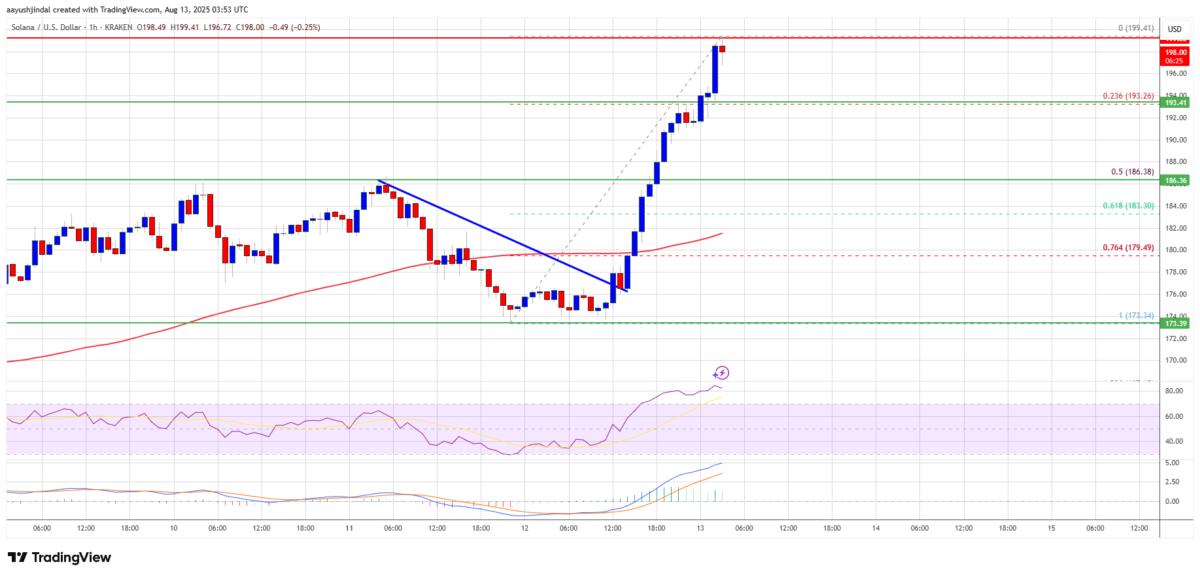
Solana bounced from support around $175, mirroring the recovery seen in Bitcoin and Ethereum. The token cleared $180 and broke past $192, even overcoming a bearish trend line at $178.
Bulls pushed SOL as high as $199 before momentum cooled, with the price now consolidating above $192 and the 100-hour moving average. On the upside, the price is facing resistance near the $200 level. The next major resistance is near the $202 level.
Source: TradingView data
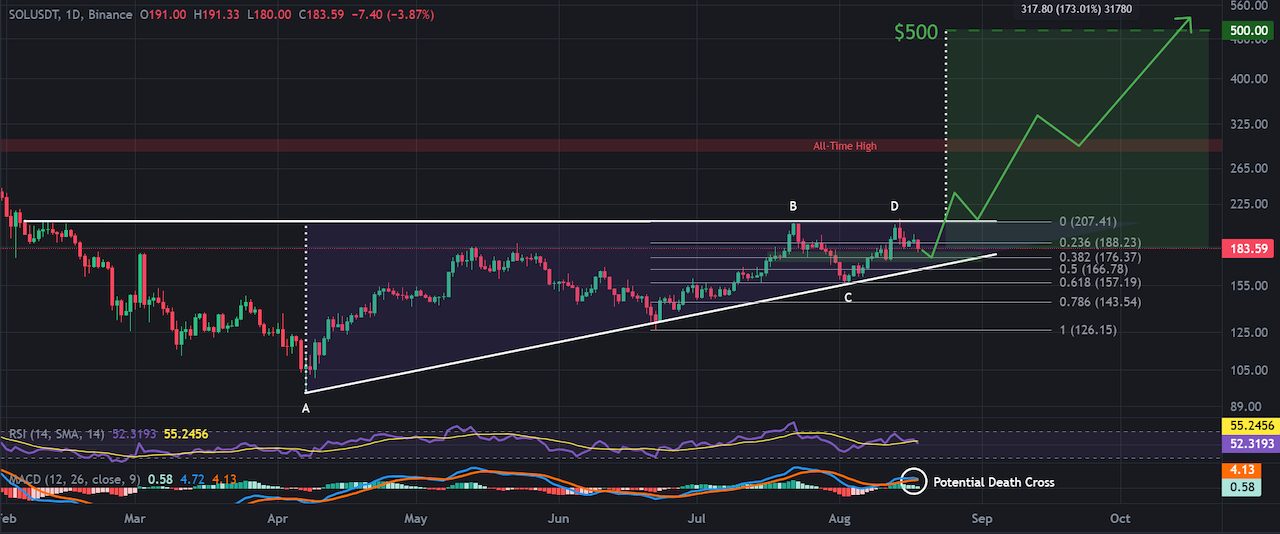
In a full bull cycle, some traders even eye $500 as a long-term target, a potential 183% gain from current prices.
Source: TradingView, Binance
As of press time, Solana is trading at approximately $181.96, marking a modest 0.54% dip over the past 24 hours and a 4.04% gain week-over-week.
The token’s 24-hour trading volume stands near $5.19 billion, while its market capitalization hovers around $98.23 billion, putting it firmly among the top-tier cryptocurrencies by valuation.