Strategy (MSTR) is still the king when it comes to digital asset treasuries.
The cryptocurrency market has lost about $33 billion over the past few days, with $1.69 billion in derivatives liquidated, according to CoinMarketCap and Coinglass. Panic has rippled through sectors that were once seen as hedge assets, particularly the bitcoin treasury stocks.
With digital asset treasuries losing favor, especially those focused on Bitcoin, firms like Strategy (formerly MicroStrategy) and its imitators are seeing their stock prices slide toward or even below the value of their crypto holdings.
Treasuries in freefall: Strategy leads, others follow
At the center of the slump is Strategy’s stock (MSTR), which has fallen about 2% over the past month, roughly in line with Bitcoin’s decline.
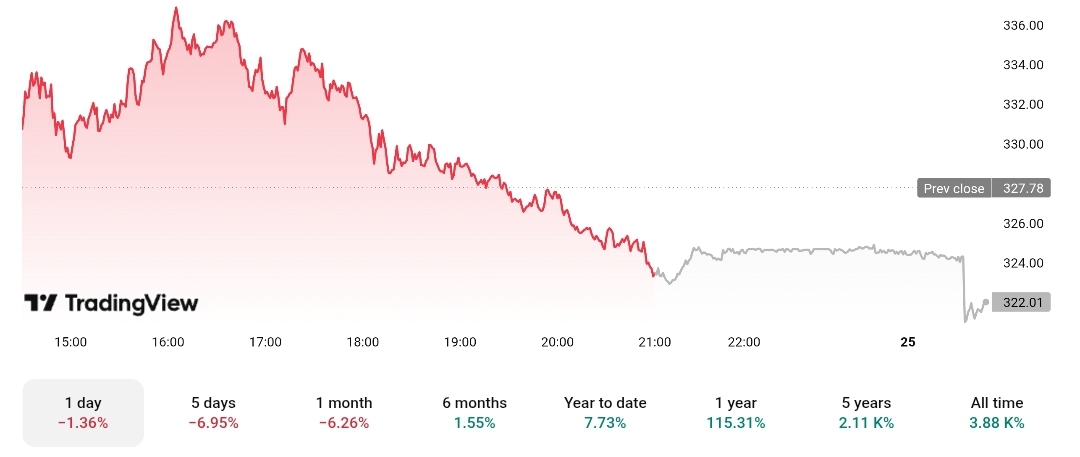
Strategy’s stock price Source: TradingView
The company made its name through aggressive bitcoin (BTC) purchases funded by debt and equity, but the recent pullback has exposed weaknesses in its premium strategy.
Many other firms followed Strategy’s approach. According to BitcoinTreasuries.net, over 180 public companies have added BTC to their balance sheets, with around 94 closely mirroring Strategy’s model. About a quarter of these now trade below the value of their crypto holdings, as per K33 report.
Companies focused on Ethereum treasuries have held up a bit better. Geoffrey Kendrick of Standard Chartered recently pointed out that ETH-based treasury firms are more established and likely to manage volatility with steadier demand.
Some headline movers among Bitcoin treasuries over the previous week:
- Metaplanet fell more than 3.09 percent.
- Kindly MD plunged 21.48 percent.
- Trump Media & Technology Group (DJT) is roughly flat (nearly 0.18 percent).
- CEP, a bitcoin-treasury spinout from Cantor Fitzgerald, dropped 11.89 percent.
Standard Chartered flagged that saturation in BTC-treasury models is elevating the risk of consolidation. As nearly 90 peer firms now hold over 150,000 BTC, six times early-year levels, smaller players may be swallowed or collapse if discounts persist.
Below is a comparison of key treasury firms and how their equity valuations stack up versus the crypto they hold.
The useful figure here is Net Asset Value (NAV), which represents the total value of a company’s assets minus its liabilities. NAV is the current market value for assets. For digital asset treasuries, the assets are crypto like Bitcoin or Ethereum.
These are rough estimates but there is one clear frontrunner:
| Company | Holdings | Crypto NAV (USD) | Market Cap (USD) | Implied Premium | Premium / Discount |
| Strategy (MSTR) | 639,835 BTC | $71.87 bn | $97.75 bn | 1.3601 | +36.01% |
| BitMine Immersion (BMNR) | 2,416,054 ETH | $8.93 bn | $10.63 bn | 1.1904 | +19.04% |
| SharpLink Gaming (SBET) | 837,230 ETH | $3.47 bn | $3.33 bn | 0.9607 | –3.93 % |
| MARA Holdings (MARA) | 52,477 BTC | $5.89 bn | $5.78 bn | 0.9804 | –1.96% |
| Upexi (UPXI) | 2,000,518 SOL | $0.436 bn | $0.386 bn | 0.8860 | –11.40% |
From this data, Strategy (MSTR) carries the steepest premium, with shares trading about 36% above the value of its bitcoin holdings. BitMine Immersion (BMNR) follows at roughly a 19% premium. By contrast, SharpLink Gaming (SBET), Marathon Digital (MARA), and Upexi (UPXI) are trading at discounts, suggesting less room for upside unless market sentiment or crypto prices improve.
It remains to be seen how this might affect digital asset treasuries going forward and if the strategy becomes less popular over time.