Apple soars to $3.9 trillion market cap off surprisingly strong iPhone 17 sales.
Despite lagging far behind in AI, Apple (Nasdaq: AAPL) managed to hit a new record high this week by doing what it does best: Selling boatloads of iPhones.
According to a new report from research firm Counterpoint, the iPhone 17 series has outsold its predecessor by roughly 14% in the USA and China over the first 10 days of sales. Apple is reportedly increasing production to keep up with rabid demand.
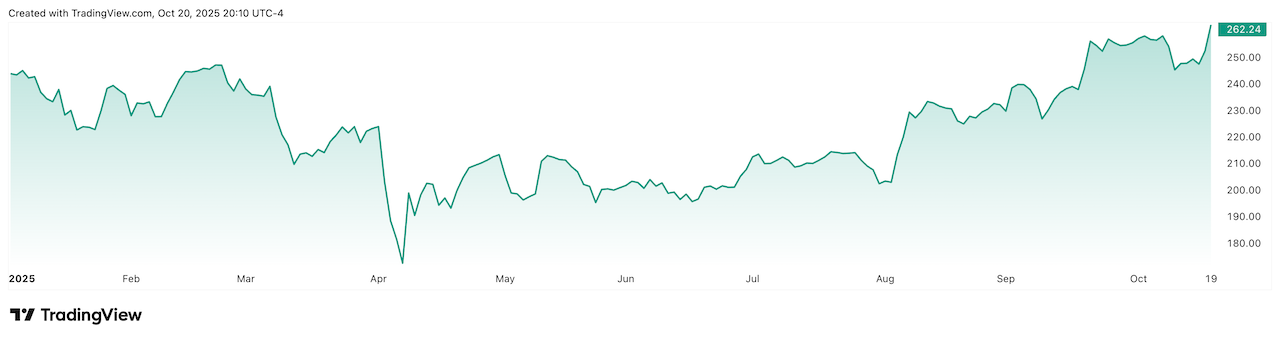
The surprising interest in the iPhone 17 lineup led several analysts to upgrade their ratings and helped power Apple stock to an all-time high of $264.38 earlier today. By the time the markets closed Apple was up 3.94% on the day.
What’s driving the renewed interest in the iPhone? There are several factors at play. The most obvious is the first major redesign of the pro model since 2023. There’s also the brand-new iPhone Air, but that device has lagged behind the two other models (Pro and base) in sales.
There’s also one underrated area that Apple appears to have hit a home run: price.
iPhone 17 pricing structure deserves accolades
At first glance, the iPhone pricing structure doesn’t appear all that different from before. The iPhone 17 still starts at $799 for a base model while the iPhone 17 Pro got $100 more expensive at $1,099 (but it also received an extra 128GB in storage).
It’s important to understand the context, however, as many businesses have been increasing prices substantially to deal with inflation and threats of tariffs.
Apple’s decision to stand pat seems to be a popular choice with consumers. It’s even more impressive when you take inflation into account.
Top 5 ‘Cheapest’ Base iPhones When Adjusted for Inflation
| Rank | Year | Model | Launch Price (USD) | Inflation-Adj. → Aug 2025 USD | Notable Features / Base Specs |
|---|---|---|---|---|---|
| 1 | 2007 | iPhone (1st gen) | $499 | ≈ $777 | 4 GB base storage | 30-pin dock | EDGE data only |
| 2 | 2025 | iPhone 17 | $799 | ≈ $799 | 256 GB base | A19 chip | ProMotion 120 Hz display |
| 3 | 2024 | iPhone 16 | $799 | ≈ $824 | 128 GB base | A18 chip | Dynamic Island |
| 3 | 2014 | iPhone 6 | $649 | ≈ $869 | 16 GB base | 4.7″ Retina HD display |
| 5 | 2016 | iPhone 7 | $649 | ≈ $871 | 32 GB base | no headphone jack | Water-resistant | 12 MP camera |
It’s also worth noting that the base iPhone 17 received one of its biggest upgrades ever, featuring a significantly improved display (the same one from the Pro) and increased storage (256GB). It’s one of the best values in iPhone history and will undoubtedly attract some customers from the Android ecosystem.
Meanwhile, the iPhone 17 Pro retains the top-of-the-line camera system and will likely be the device of choice for content creators. The size of the Pro Max is also now a selling feature as the larger iPhone Plus model was retired.
The black sheep of the iPhone 17 lineup, however, is the new iPhone Air. At $999, and with significantly reduced capability compared to the base model and the Pro, it appears to be a niche product.
Apple Intelligence remains MIA. Does it matter?
The surprising performance of the iPhone 17 marks a stark contrast to Apple’s previously lackluster year.
Apple has fallen far behind in the AI arms race to companies like OpenAI and Google. The highly-touted Apple Intelligence service was barely mentioned in iPhone 17 marketing. The full rollout of Apple Intelligence has been delayed to 2026 but, it’s questionable at this point what the service will even look like in the end.
There was also a report that Apple was in talks with Google to use Gemini to power some aspect of Apple Intelligence.
Right now, however, analysts are starting to wonder how much it matters.
Now that Apple has proven it can still sell a significant number of iPhones without Apple Intelligence, the conversation has shifted slightly.
Here are three of the most obvious narratives that spring to mind:
- Apple might not need an AI component as much as previously thought.
- The stock still might get a significant boost if an improved Apple Intelligence and Siri launch in 2026.
- If there is an AI bubble, Apple might be uniquely insulated from the fallout.
It will be interesting to see how those three narratives play out over the next 6-12 months. For the time being, however, it appears that consumers still very much want to purchase iPhones, regardless of AI.