Oil prices have a major influence on the global economy, and the Organization of the Petroleum Exporting Countries (OPEC) and the other oil producers allied to them within the larger OPEC+ group play a pivotal role in shaping market dynamics for this essential commodity.
The alliance’s members work together to coordinate production policies to control the supply and price of crude, the mainstay of the economies.
OPEC uses production quotas, strategic alliances, and market signaling to manage the oil market. Since 2016, when OPEC joined forces with Russia and other oil producers forming the OPEC+, they have been collectively controlling about 55% of global output.
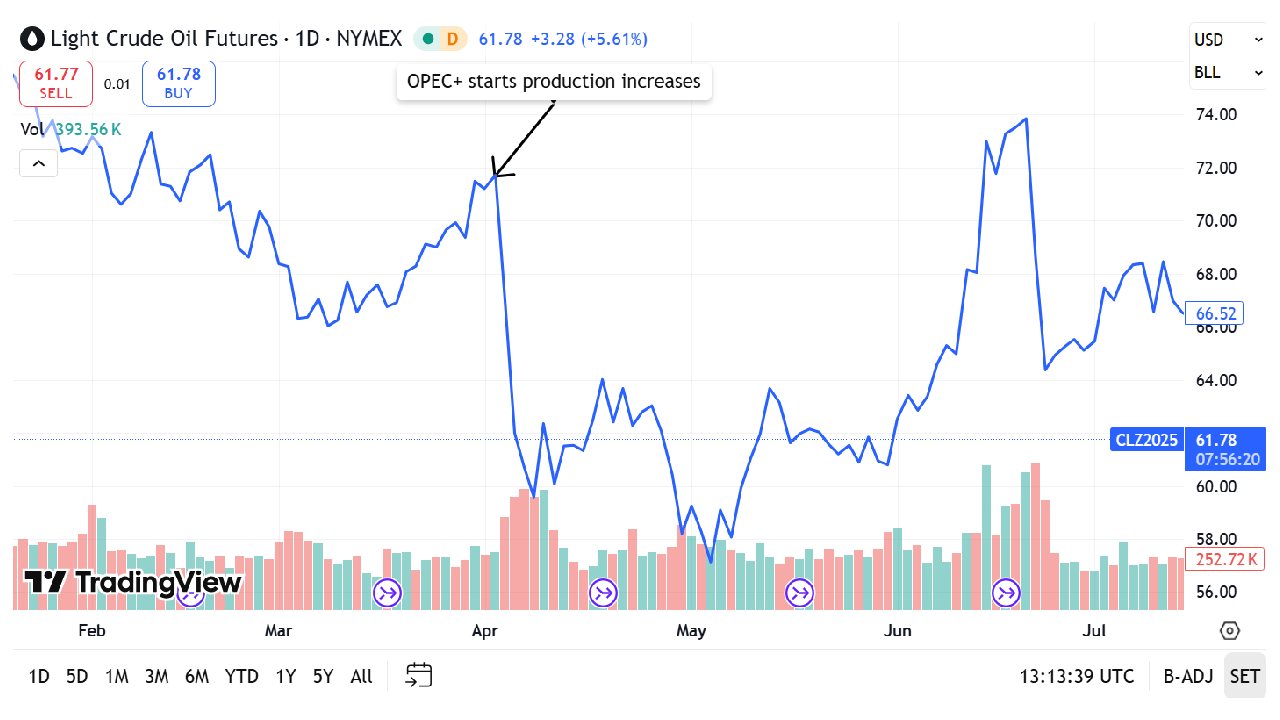
So far this year, OPEC+ has reined in output increases because of rising concerns about an oil glut that could drive prices of the commodity down. Brent oil prices have been in the range of $60 to $80 since OPEC+ began its production increases in April, down from $82 per barrel at the start of 2025.
What is OPEC?
OPEC, the Organization of the Petroleum Exporting Countries, headquartered in Vienna, is an international body whose members are oil-producing nations. It helps set the price of oil by collaborating on production quotas.
Its stated goal is to coordinate and unify its members’ petroleum policies to secure fair and stable prices for producers, ensure an efficient, economic, and regular supply to consumers, and provide a fair return on capital for investors.
OPEC’s member states
The founders of OPEC were Saudi Arabia, Iraq, Iran, Kuwait, and Venezuela. Gradually, other countries were added, including Qatar (1961), Indonesia (1962), Libya (1962), the United Arab Emirates (1967), Algeria (1969), Nigeria (1971), Ecuador (1973), Gabon (1975), Angola (2007), Equatorial Guinea (2017) and Congo (2018). However, Angola, Ecuador and Indonesia are no longer members of the organization.
What is OPEC+
OPEC+ is an adjunct of OPEC that includes additional oil-producing countries outside the organization. It was formed in 2016 in response to a sharp decline in oil prices due to the rising production of U.S. shale oil. Like OPEC, the primary goal of OPEC+ is to coordinate oil production and maintain market stability.
The larger alliance of OPEC+ enhances the group’s market leverage but also introduces complexities. For example, Russia’s sustained cooperation, despite Western sanctions following the invasion of Ukraine, highlights the fragile interdependence within OPEC+.
Member states of OPEC+
In addition to the 12 current members of OPEC, the non-OPEC members of the OPEC+ cartel include: Russia, Azerbaijan, Oman, Kazakhstan, Sudan, Bahrain, Brunei, Malaysia, South Sudan, and Mexico. Brazil joined the group in February this year. However, its participation is non-binding, meaning it has no obligation to cut production.
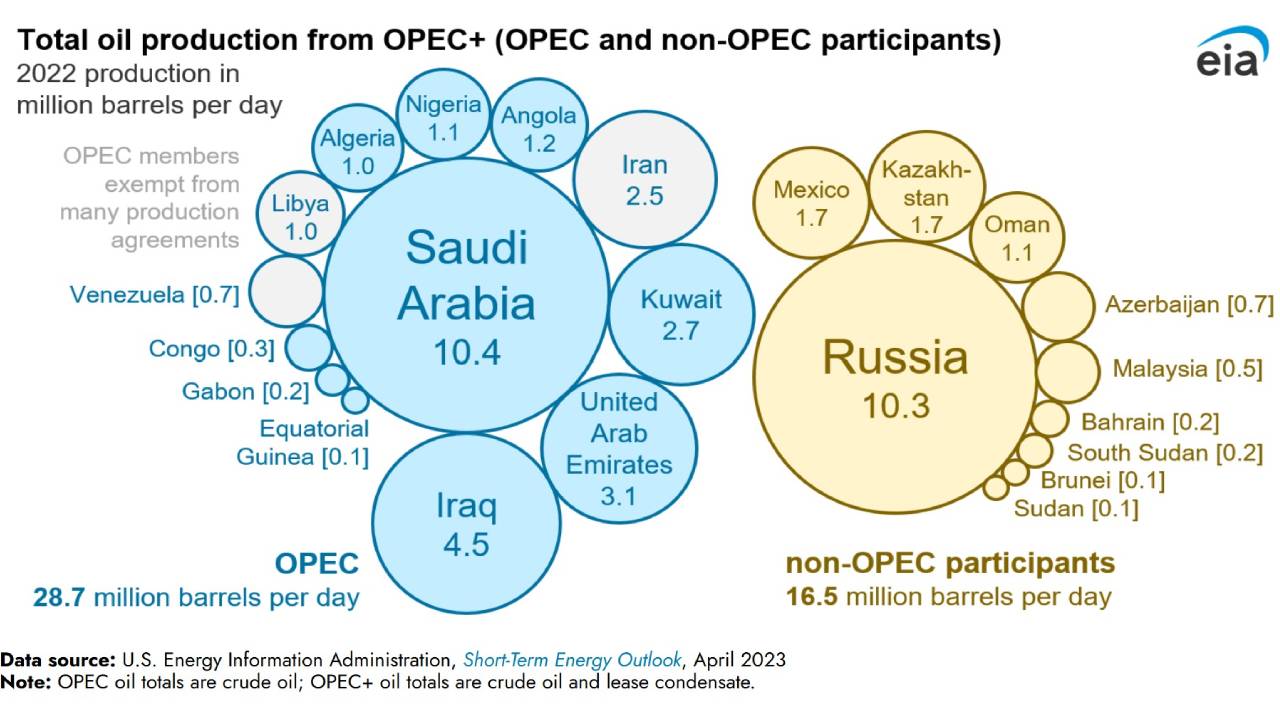
Note: The image still shows Angola, which quit in January 2024 amid disputes over its output quotas. It doesn’t show Brazil, which joined OPEC+ as a non-binding member in February 2025.
The History of OPEC and OPEC+
In 1960, Iraq, Iran, Kuwait, Saudi Arabia, and Venezuela formed the Organization of the Petroleum Exporting Countries, or OPEC, in Baghdad. The group coordinates and unifies member countries’ petroleum policies:
- to secure fair and stable prices for producers,
- ensure an efficient, economic, and regular supply to consuming nations,
- and provide a fair return on capital for industry investors.
Before its creation, the “seven sisters,” a group of multinational energy companies, dominated the international oil market until the 1970s. They were: Standard Oil of New Jersey (Exxon), Standard Oil of New York (Mobil), Standard Oil of California (Socal/Chevron), Texaco, Gulf Oil, British Petroleum (BP), and Royal Dutch Shell.
OPEC emerged during a period of significant global change, marked by widespread decolonization and the rise of many new independent states in the developing world.
By 1968, OPEC’s Declaratory Statement of Petroleum Policy in Member Countries underscored the “inalienable right of all countries to exercise permanent sovereignty over their natural resources in the interest of their national development.”
OPEC+ began in 2016 when the original OPEC allied with 10 non-OPEC oil-producing countries, including Russia, to manage oil and stabilize prices in response to falling prices caused by a surge in US shale oil production.
What does OPEC do?
OPEC’s actions significantly influence global oil prices due to the group’s dominant position:
- Market Share and reserves: OPEC countries collectively produce about 40% of the world’s crude oil. They account for approximately 60% of global petroleum trade. Critically, they control more than 80% of the world’s proven oil reserves.
- Controlling supply: OPEC members meet regularly to set oil production targets or quotas, effectively deciding how much crude oil to sell on the global market.
The main forum of join decision making of OPEC is the ministerial meeting (Conference) twice a year. Sometimes, OPEC holds extraordinary meetings to address urgent matters.
The decisions and announcements from key members, particularly Saudi Arabia (OPEC’s largest producer), often create market ripples that influence global crude oil prices, even without formal action by the organization.
How do OPEC and OPEC+ coordinate their actions?
OPEC and OPEC+ coordinate their actions primarily through collective decision-making regarding crude oil output.
This coordination is formalized by the Declaration of Cooperation (DoC), an agreement signed in late 2016 between the members of OPEC (Organization of the Petroleum Exporting Countries) and a group of major non-OPEC oil-producing countries (the “plus” in OPEC+).
The key mechanism for coordination is the holding of regular ministerial meetings where representatives from member countries assess global oil market supply and demand. They then agree on overall production targets for the group, which are then distributed as individual country quotas.
To ensure that members adhere to the agreed-upon targets the Joint Ministerial Monitoring Committee (JMMC) tracks compliance and recommends actions to address any overproduction.
According to OPEC’s website, the next scheduled meetings are as follows:
- The 63rd meeting of the Joint Ministerial Monitoring Committee (JMMC) is due on November 30, 2025
- The next (40th) OPEC and OPEC+ ministerial meeting will also take place on November 30, 2025.
What other factors affect the price of oil?
Supply and demand, shale production, and geopolitics all significantly influence oil prices by affecting the balance between how much oil is available and how much is needed.
Shale production can increase global supply, putting downward pressure on prices, while geopolitical events like conflicts or trade uncertainty can disrupt supply, increase costs, and create market volatility.
Supply and demand
A high demand coupled with low supply leads to higher prices, while ample supply and low demand drive prices down.
High demand and insufficient supply can occur during peak consumption periods, such as summer driving seasons.
Supply typically outstrips demand during periods of sluggish economic activity. Increased energy efficiency, again, can lead to lower demand, while a surge in production can increase supply, putting downward pressure on prices.
Geopolitics
Geopolitical instability in major oil-producing regions can directly disrupt supply through conflict or sanctions. Those both create uncertainty in the market, which can drive prices up due to fears of future supply shortages, even if supply is not immediately affected.
Fight on climate change
The fight against climate change affects oil prices by influencing supply, demand and investment through policies such as carbon taxes and regulations.
Such policies can increase the cost of oil production and consumption, raising prices in the short term, to encourage a shift to alternatives.
However, long-term effects are more complex, as investment in renewable energy and electric vehicles (EVs) could eventually lower overall energy costs and impact oil demand.
How does OPEC and OPEC+ influence the price of oil?
OPEC and the expanded OPEC+ alliance impact the price of oil primarily through their collective ability to manage the global supply of crude oil, which is their core function as an organized group.
Setting quotas or targets for production
When the alliance determines that the market is oversupplied or that prices are too low to meet their revenue needs, they announce and implement coordinated production cuts. Conversely, when the market appears tight or prices are rising too high, which could dampen global demand, they can agree to increase production.
Influencing market and investor sentiment
Oil prices are heavily traded on futures markets, where contracts are bought and sold based on what participants believe the price will be in the future. Any announcement from the alliance — even the threat or discussion of a supply change — causes immediate price movement in these financial markets.
Controlling spare production capacity
Furthermore, the control of spare production capacity, which is predominantly held by OPEC members, most notably Saudi Arabia, significantly impacts the oil price. Spare capacity refers to the amount of oil that can be brought to the market relatively quickly and sustained for a period of time. This capacity serves as a critical buffer against unforeseen global supply shocks.
The cartels punish non-cartel competitors
Finally, OPEC+ impacts oil prices through its role in defending its long-term market share against rising non-OPEC competition, such as US shale. Historically, when non-OPEC production has surged, the alliance has sometimes opted to dramatically increase its own output, intentionally flooding the market to drive prices down.
This strategy, though painful for their own revenues in the short term, makes higher-cost production from rivals economically unviable, thus limiting the growth of competing supply and preserving their dominance over the long run.
What are the largest oil producing countries in the world?
The United States, Saudi Arabia and Russia are the largest oil-producing countries in the world.
Oil production in 2024, according the data from the Energy Institute
Total world: 96.89 barrels a day
- United States: 20.13 million barrels a day; share: 20.8%
- Saudi Arabia: 10.86 million barrels a day; share: 11.2%
- Russia: 10.75 million barrels a day; share: 11.1%
What is the price of oil?
Let’s look at what we mean when we talk about the “oil price.”
The term “crude oil” is a broad one, and the market is typically categorized in two main ways: by the physical quality and origin of the oil, which gives us benchmarks such as WTI and Brent, and by the trading mechanism used to buy or sell it, which distinguishes spot and futures prices.
Crude oil is generally classified based on its density (API gravity—the lighter, the better) and its sulfur content (the lower, the “sweeter,” and easier to refine.) Both West Texas Intermediate (WTI) and Brent are considered light and sweet crude, making them ideal for producing gasoline and diesel.
WTI: West Texas Intermediate (WTI) is the primary benchmark for the United States oil market. It comes from US oil fields (primarily in Texas and North Dakota) and is delivered and priced at Cushing, Oklahoma, a major landlocked storage and pipeline hub. WTI is known for being very light and very sweet (lower API gravity and sulfur content) than Brent, making it marginally higher quality for refiners.
Brent Crude: It’s the leading global price benchmark. It represents the pricing for about two-thirds of the crude oil that trades internationally. It originates from oil fields in the North Sea (including Brent, Forties, Oseberg, Ekofisk, and Troll, or BFOET). Being a waterborne crude, Brent is easily loaded onto vessels and shipped globally, giving it greater logistical flexibility than WTI.
How is the international price of oil determined?
Spot and futures oil trading: The price of crude oil is determined by two main trading mechanisms: spot and futures. The spot price is the current market price at which a barrel of crude oil can be bought or sold for immediate delivery (“on the spot”).
In contrast, crude oil futures contracts are the most widely used instruments for trading oil. A futures contract is a legally binding agreement to buy or sell a specific quantity of crude oil (usually 1,000 barrels) at a predetermined price on a predetermined date in the future.
Current oil price trends
The following chart shows how US West Texas Intermediate futures have been on a downward trend as eight members of OPEC+ began a gradual expansion of output even amid concerns of an oversupply emerging.
The International Energy Agency in its recent monthly report warned of a larger supply glut for 2026 than it had previously estimated.
FAQs
How does OPEC and OPEC+ influence global oil prices?
What factors limit OPEC and OPEC+’s control of the market?
What are the 5 aims and objectives of OPEC?
What is the significance of oil prices for the world economy?
Who is the largest oil exporter in the world?
Why are oil prices dropping right now?
References
- Reuters: OPEC+ restrains production amid oil glut
- Current oil prices
- Hellenic Shipping article on OPEC+
- WTI crude futures on the CME website
- OPEC report on holding down production
- United States Oil Fund facts
- Invesco DB Oil Fund facts
- ProShares K-1 Free Crude Oil Strategy ETF (OILK)
- SPDR S&P Oil & Gas Exploration & Production ETF (XOP)
- Energy Select Sector SPDR Fund (XLE)
- Vanguard Energy ETF (VDE)
- Fidelity Select Energy Portfolio (FSENX)