When you invest in foreign companies, you’re naturally exposed to the fluctuations of the foreign currency market. Currency-hedged ETFs mitigate that risk.
Investing in overseas markets through exchange-traded funds (ETFs) is an effective way to diversify risk and mitigate some of the challenges associated with international investing. Currency fluctuations, however, can still negatively impact your returns if you are investing through unhedged ETFs. On the other hand, you can eliminate or at least minimize the risk of currency fluctuations by using currency-hedged ETFs.
If you plan on investing overseas, it is crucial that you understand the differences between currency-hedged vs unhedged ETFs to protect and build your wealth across different market environments, especially in the present unstable scenario, where countries are using tariffs to meet their political ends.
What are currency-hedged ETFs?
ETFs are themselves a risk-reducing financial instrument as they offer diversification. A standard ETF offering exposure to foreign securities, however, doesn’t protect investors against currency fluctuations, and this is where currency-hedged ETFs come in.
A currency-hedged vehicle, in this case an ETF, tracks the values of overseas securities, thereby exposing investors to minimal currency risk. Such ETFs use forward contracts for the base currency to hedge the risk in case of an increase in currency price.
For example, suppose you live in Canada and invest in U.S. securities via global ETFs, and the Canadian dollar appreciates against the USD. In such a scenario, your investment value will drop as you would receive less in Canadian dollars if you sell. However, if you use hedged ETFs, they will tend to outperform unhedged funds in periods when the Canadian dollar is appreciating.
The natural risks of investing in foreign ETFs
When investing internationally, you are actually making two investments – one in the foreign asset and the other in the foreign currency. So, you are not just betting on the success of the foreign asset, but also on the fluctuations of the foreign currency market.
Even the best ETFs, if unhedged, only help minimize the risks associated with investing in foreign assets. But what about currency risk? A rise or fall in the base currency against the foreign currency can significantly impact your profits if you sell your foreign investment and convert the proceeds into the local currency.
Currency fluctuations are a bigger threat now, with nations using tariffs to coerce other countries to fulfill their demands. A change in tariffs does have an impact on the currency rate between the two countries.
How does a currency-hedged ETF work?
In general, a currency-hedged ETF uses the same asset allocation as an unhedged ETF if the two are from the same provider and track the same index. A currency-hedged ETF, however, works by further using forward currency contracts to hedge or protect the portfolio from currency fluctuations.
It must be noted that those forward currency contracts correspond to the value of the ETF’s assets or are tied to the underlying assets. The contract locks in a future exchange rate, allowing investors to convert the proceeds from foreign investment into local currency at a predetermined rate.
For instance, if the Canadian dollar appreciates against the US dollar, it reduces the value of an investment for a Canadian. If the Canadian investor has a currency-hedged ETF, it will be executed to offset the losses from currency fluctuation.
On the other hand, if the Canadian dollar weakens or depreciates, you would not benefit from it because your position is hedged.
Who is a currency-hedged ETF for?
A currency-hedged investment vehicle helps to reduce the risk associated with currency volatility. Thus, it is used by both institutional and individual investors. It is particularly suitable for investors who want to gain exposure to international markets without incurring additional risk associated with investing.
Furthermore, currency-hedged ETFs are also helpful for investors who understand the foreign exchange market and believe that a currency is performing abnormally well or poorly, and are aware of the resulting risk to their overseas investments.
Long-term investors may also use a hedged ETF if they are worried that currency movements will reduce the long-term returns of their globally diversified portfolio. Currency-hedged ETFs are also useful for investors whose country is at war (military, political, or otherwise) with the country in which they are investing.
Why would anyone choose an unhedged ETF?
Unhedged ETFs expose investors to both foreign investment and foreign currency. Thus, they are a good option for investors who want to benefit from the fluctuations in the foreign currency and believe an unhedged ETF can offer a hedge against a weakening domestic economy.
Furthermore, unhedged ETFs may also prove a good option for investors who expect the home currency to drop in the near future. If the foreign currency appreciates against the home currency, the returns from the unhedged ETF will be magnified.
A hedged currency ETF also comes with additional costs, reducing the overall return. So, an unhedged ETF helps investors avoid this additional cost, resulting in a higher return if the foreign currency performs well.
The pros and cons of currency-hedged ETFs
Currency-hedged ETFs offer investors protection against currency fluctuations, but they are not without drawbacks. Investors need to know and understand the pros and cons of currency-hedged ETFs to maximize their investment returns.
Pros
- Hedged currency ETFs protect the portfolio when the home currency strengthens, or appreciates
- Currency fluctuations can lead to significant volatility in international investments, but the use of hedged ETFs provides some stability, especially during turbulence in the currency market.
- Use of hedged currency ETFs allows investors to focus on foreign securities without worrying about currency fluctuations. Moreover, the hedged ETFs more closely mirror the performance of the underlying companies.
- Currency-hedged ETFs are a simple and easy way to implement a hedging strategy.
Cons
- Hedged currency ETFs cost more than unhedged ETFs, thereby increasing the fund’s expense ratio. Higher costs may erode the returns, especially during times when the currency hedge isn’t producing expected result
- Hedged currency ETFs aren’t always a perfect hedge, especially for less liquid currencies and ETFs covering emerging markets. Such ETFs don’t accurately mirror the underlying market return
- By using hedged ETFs, investors miss out on opportunities when the home currency depreciates or weakens against the foreign currency. Such a missed opportunity may pinch significantly during currency depreciation.
Currency-hedged vs unhedged ETFs – A quick comparison
Let’s take a simple real-world example to understand the differences between currency-hedged vs unhedged ETFs.
For a U.S. investor looking to invest in the Japanese market, the iShares MSCI Japan ETFs (hedged) performed better than the unhedged version of the same ETF during 2023-2024. The iShares MSCI Japan ETF tracks the Japanese stock market.
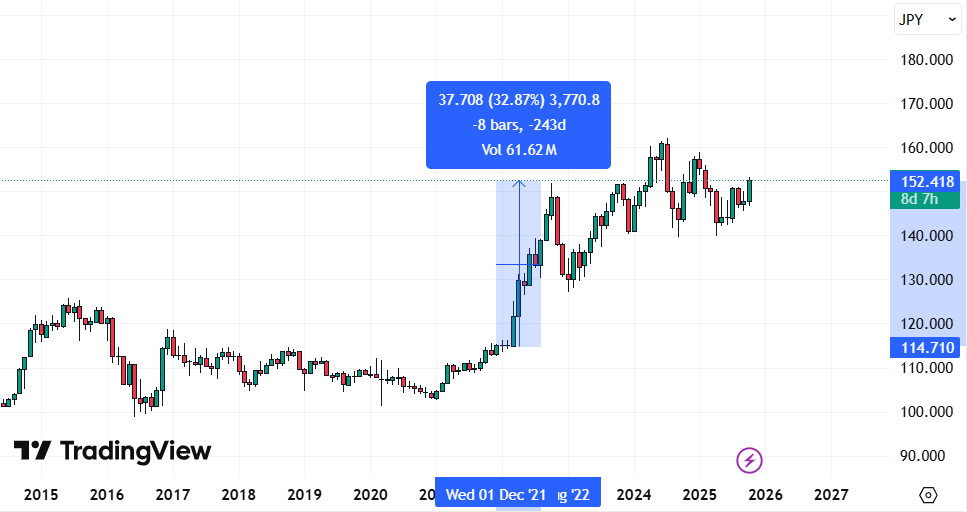
During 2023-2024, the Japanese yen lost significant value against the U.S. dollar, thereby significantly impacting the unhedged ETFs. On the other hand, the hedged ETFs protected the U.S. investors from the negative effect of currency movements.
Let’s understand how the two similar ETFs gave different results during the same period:
| Factor | iShares MSCI Japan ETFs (hedged) | iShares MSCI Japan ETFs (unhedged) |
| Return | +48% | +24% |
| Performance | Gained due to the overall increase in Japanese stock prices | Gained due to the overall increase in Japanese stock prices |
| Currency exposure | Used forward contracts to protect exposure to currency movements | Fully exposed to currency movements |
| Impact | Protected pure returns from the Japanese stock market against currency movements | Returns from the stock market were eroded when converted back to the USD |
As can be seen in the USD/JPY chart, the Japanese Yen lost significant value against the U.S. Dollar between 2021 and 2023, i.e., from 104 JPY in January 2021 to almost 150 JPY by the end of 2024.
It must be noted that, similar to the above example, involving JPY and USD, opportunities exist for investors in other currencies, such as EUR (Euro), AUD (Australian dollar), CAD (Canadian dollar), GBP (British Pound), and CNY (Chinese Yuan). Furthermore, the principles of hedged and unhedged currency ETFs are the same for all currencies.
The iShares MSCI Japan EUR Hedged UCITS ETF (IJPE.L) and other ETFs are available on eToro.
The bottom line
Whether to use hedged or unhedged currency ETFs is an entirely personal decision that should be based on investment objectives, risk appetite, and understanding of the currency markets.
If you don’t want to expose yourself to currency fluctuations or prefer stable returns, you may favor hedged currency ETFs that come with extra cost. Though hedged ETFs offer protection, they may have significant opportunity costs, especially when the home currency is weakening.
Similarly, if you expect the home currency to weaken against the foreign currency, you might take the risk of investing in an unhedged fund to pocket some extra returns.