Smart contracts are seeing rapid adoption. As of February 2025, Ethereum alone has recorded 69,788,231 deployed contracts. In 2023, new EVM smart contracts across major blockchain networks grew 303% year-over-year.
In short, smart contracts are programs on blockchains that execute when predefined conditions are met, transferring assets or updating state without the need for a central operator. And you encounter them behind exchanges, lending, digital identity, on-chain ownership, and governance tools every day.
This article explains how smart contracts work in practice, clears up myths around immutability versus upgradeability, and shows the trade-offs you should check before you use one. We’ll also map the main application areas and give you plain-language checkpoints for risk, audits, security, and costs upfront.
What is a smart contract?
A smart contract is application code stored on a blockchain that runs automatically when predefined conditions are met. It encodes agreement logic and changes on-chain state in a deterministic way, without a central operator.
Public-chain activity is transparent and pseudonymous, not fully anonymous. When you submit a transaction that calls a contract, network validators execute the same code, reach the same result, and record the outcome on-chain for anyone to audit, as opposed to traditional contracts.
Smart contracts, or Bitcoin smart contracts, build on Bitcoin’s basic idea of sending and receiving money without needing an intermediary, such as a bank. Furthermore, since these contracts run on blockchain, they ensure security, reliability, and accessibility.
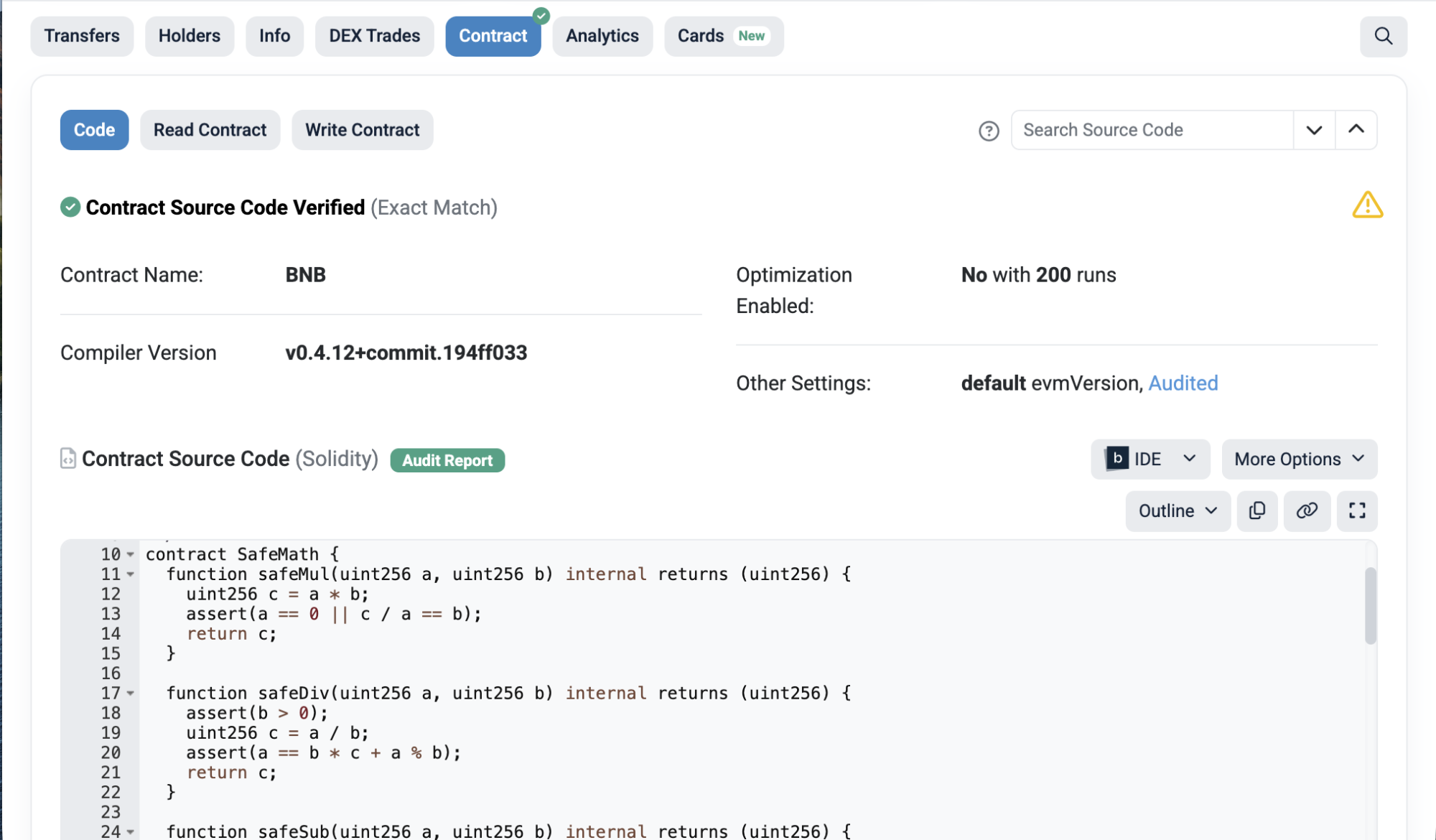
The most popular coding languages for digital contracts are Solidity and Rust.
How do smart contracts work?
Nick Szabo, a computer scientist, was the first to propose smart contracts in the 1990s. While describing these self-executing contracts, Szabo compared them to a vending machine selling soda cans. Just like a vending machine automates a sale without human interaction, a smart contract can automate any digital transaction.
Anyone can deploy a contract; its bytecode and storage live at a blockchain address. When a user (or another contract) calls a function, validators execute that function on every node, charge gas, and persist the resulting state changes. Validators don’t “check the business terms”; they just run the code. Because execution is deterministic, every honest node reaches the same result, and the network accepts it.
A smart contract primarily has four major components that ensure its execution:
1. Code: This defines the logic, terms, and conditions of how the contract will operate, or what action will trigger when a specific condition is met.
2. State variables: These are variables within a smart contract that hold information on the current state of the contract’s data. For instance, state variables in a payment contract may hold information on the buyer, seller, price, and more.
3. Functions: These are basically the actions that a smart contact performs when certain conditions are met. For instance, transferring the asset when the payment is made, updating data, and more.
4. Events: A smart contract sends messages or events to inform the network of the completion of specific actions. Such messages can be used by other apps or contracts to make adjustments accordingly.
All four of these components work together to ensure the execution of a smart contract.
The history and evolution of smart contracts
Nick Szabo, a computer scientist and cryptographer, first proposed the concept of smart contracts in 1994. However, the concept was only practically implemented after the advent of blockchain technology and cryptocurrencies.
In 2008, Satoshi Nakamoto’s creation of Bitcoin was the first major breakthrough in blockchain-based smart contracts. Szabo, who has often been rumoured to be the real Satoshi Nakamoto, defined smart contracts as computerized transaction protocols that execute a contract’s terms.
However, smart contracts have changed a lot from what Szabo first conceptualized, or even from the simple smart contracts that power Bitcoin transactions. These self-executing contracts now involve more complex conditions and play a pivotal role in a wider range of applications, including non-financial ones.
The evolution of smart contracts can partly be credited to the development of Ethereum in 2015. Developed by Vitalik Buterin, Ethereum allowed the development of more complex, programmable smart contracts.
What are smart contracts used for?
Since crypto contracts facilitate the execution of agreements, they can be practically applied to achieve different objectives in varying fields. The simplest use case of a smart contract is executing a transaction between a buyer and seller.
For example, a buyer of mobile chips can set up a payment using a smart contract, which releases the payment automatically to the seller after the delivery confirmation. Once the supplier sends the shipment and confirms the same as per the terms set in the smart contract, the payment is released automatically.
Similarly, smart contracts can be used in different sectors, including finance, real estate, supply chain, tokenized stocks, and commodity trading, healthcare, music, and many more. DeFi (Decentralized Finance), for instance, is an important part of the crypto world that uses smart contracts to make traditional financial services available to crypto users.
In real estate, for instance, a smart contract can transfer the ownership of a property once a certain amount is transferred to the seller’s account or wallet.
Similarly, smart contracts can be used in the music industry to ensure royalties are rightly credited to the owner’s account as and when the song is used commercially. Furthermore, crypto contracts can also be used to resolve ownership disputes.
The most popular smart contract-powered applications
Most decentralized applications are now powered by smart contracts. Some of the most popular ones are:
- Digital identity and verifiable credentials: Issue, hold, and verify credentials or attestations without a central database. Users control identifiers and consent to proofs instead of sharing raw data.
- Decentralized finance (DeFi): Automated exchanges, lending markets, interest-bearing vaults, and collateralized borrowing all run by code, settling transparently on-chain.
- Stablecoins and tokenized real-world assets: Mint and burn fiat-referenced tokens and on-chain representations of treasuries, invoices, or commodities, with rules enforced by contracts.
- Supply-chain provenance: Track goods with on-chain events and tokenized receipts so retailers and regulators can verify origin, custody, and compliance.
- DAO governance: Token-weighted voting, treasuries, and proposal execution use contracts to coordinate budgets and roadmap decisions without a single controller.
- NFTs and gaming: Mint unique digital items, enforce royalties, run on-chain marketplaces, and manage in-game assets that users can trade outside the game.
Can a smart contract be changed?
Not always, but often. Contracts can be:
- Immutable deployments. The code can’t change once deployed.
- Upgradeable via proxy. A proxy contract holds state and delegates logic to an implementation contract that an admin can replace.
- Configurable. Admin roles can change fees, pause transfers, or update parameters.
What does “renounce ownership” mean?
Many contracts use an owner or admin role. “Renouncing” sets that role to a null address, removing privileged control. If a proxy’s admin is also renounced, neither logic upgrades nor admin-only actions are possible afterward.
Until then, upgrades or admin actions may still occur. Use clear docs to tell users whether a contract is immutable, upgradeable, or renounced. Tie this nuance back to earlier claims about “irreversibility/immutability.”
Pros and cons of smart contracts
Smart contracts are now an inseparable part of the crypto world, but they are not without drawbacks. Let’s look at the pros and cons of these self-executing contracts:
Pros
- Autonomy: Similar to cryptocurrencies, smart contracts allow parties to deal directly with each other, thus removing the need for intermediaries.
- Cost-efficient: Smart contracts eliminate intermediaries, including brokers, lawyers, notaries, and more, resulting in savings. Moreover, they eliminate paperwork.
- Reduce fraud: All smart contracts are stored on the blockchain, making them hard to modify. Moreover, any violation in a smart contract can be detected by the nodes in the network.
- Efficient: Smart contracts are self-executing and don’t require any intermediaries, resulting in faster and more efficient execution.
- Record keeping: All smart contracts are stored in the blockchain and can be easily accessed with a complete audit trail.
Cons:
- Immutable: No changes can be made to a smart contract once set up. Even if changes are required due to any human error in coding, a new contract has to be made.
- Loopholes: There are loopholes in coding that can be used to execute contracts in bad faith.
- Lack of regulations: Lack of coordinated regulations in the crypto and blockchain world make smart contracts less trustworthy.
The bottom line
Smart contracts’ ability to self-execute based on predefined protocols makes them one of the most innovative and promising tech developments. These contracts do away with the need for intermediaries, while still maintaining trust between the parties.
Many of us, however, may not yet be ready to sell our valuable assets via an irreversible electronic smart contract. Even though smart contracts are practically useful in most industries, they still carry an element of risk and are still evolving.
But as the legal and regulatory frameworks surrounding crypto and blockchain become more robust, smart contracts will undoubtedly play a potentially significant role in the future of our economy and society.