web stats

R.T. Young

avatar R.T. Young is a management consultant, econometric adviser, and an initial stage venture capital fund manager. He has worked with clients across the United States, Europe, and Asia. R.T. writes about financial economics and policy when not advising clients or businesses. He has a Ph.D. in Business Economics and an undergraduate degree in Applied Physics. His past experience includes work in the industrial chemicals industry, the biomedical industry, government, and the investment management industry.


Retail Sales in Perspective

May 14, 2013
YoY Growth Rate, Retail Sales

The Commerce Department’s retail sales figures came in relatively decent, with total retail sales coming in up 0.1 percent at $419 billion.  The second most quoted figure related to the monthly retail sales report is retail sales less the automobile sector, and this indicator coming in down 0.1 percent over the prior month, or $340 billion. Retail Sales Figures Encouraging? The market generally considered the today’s retail sales figures as encouraging, in that the 0.1 percent growth beat economists’ expectations of -0.3 percent.  The positive month over month growth also represents a movement in the opposite direction from the retail sales figure of the prior month, which was down 0.5 percent. What do today’s April’s retail sales figures mean in perspective? Well, in the context of the recent almost two year deceleration trend, today’s figures represent a reversal.  The year over year growth rate reached a recent high at 9.21 percent in June 2011.  Since then, the year over year growth rate has declined to today’s figure of 3.65 percent. Is April’s retail sales figure uptick to 3.65 percent something more than statistical noise in what appears to be a downward trajectory? Here’s a longer historical time series to answer
Read More »


Not A Lot Not To Like About Today’s Employment Report

May 3, 2013
Employment Growth from 1990-2013 through April

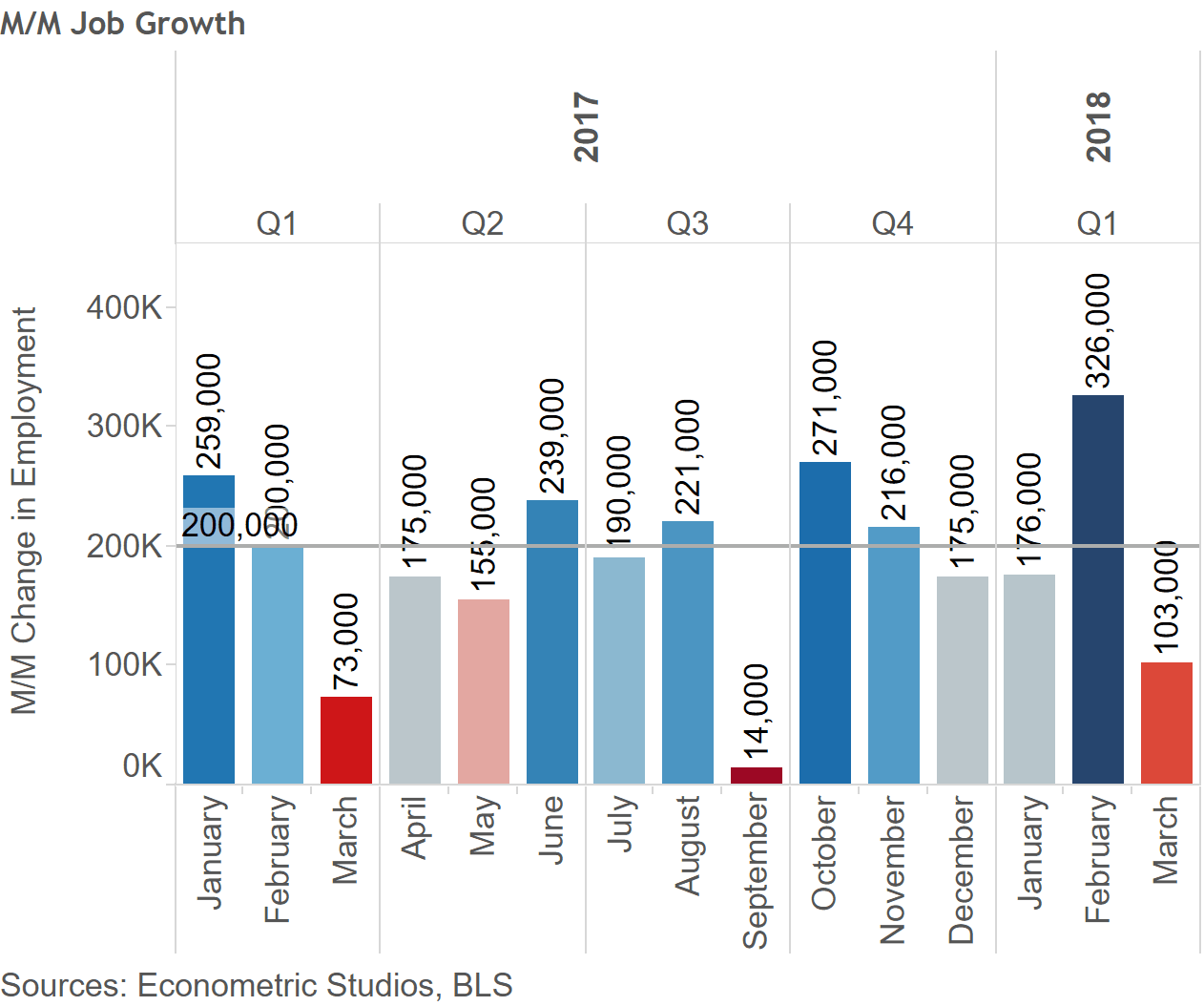
The much anticipated Labor Department’s estimate of employment growth for the month of April came in today at +165K, growing from a revised 135.309 million in March to 135.474 million nonfarm employment in April. The March estimate was also revised upward from +88K to +138K. In short, there’s not a lot not to like in today’s employment report (at least for those with low expectations of the labor market), with the broad aggregates coming in above general expectations.  Another positive signal from the report is that government employment is declining, representing an encouraging sign for those concerned about the long-term productive nature of the economy and the costs associated with financing government employment. To put today’s report in perspective, the April employment figures put the total seasonally adjusted employment growth, based upon the employer survey, at 783K, about where things stood at this point of the year as in 2004.  Perhaps not surprisingly, judging by the reaction, the market appears to think the year is 2004, with really good things ahead for the next couple of years. In comparing the 2013 experience to prior years since 1990, the 2013 figures so far would give 2013 a rank of 13th out
Read More »


Is the Federal Reserve Waging a War on Savers?

May 3, 2013
Is the Federal Reserve Waging a War on Savers?

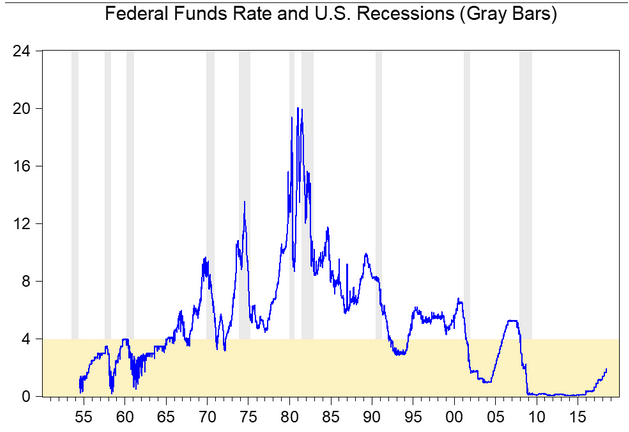
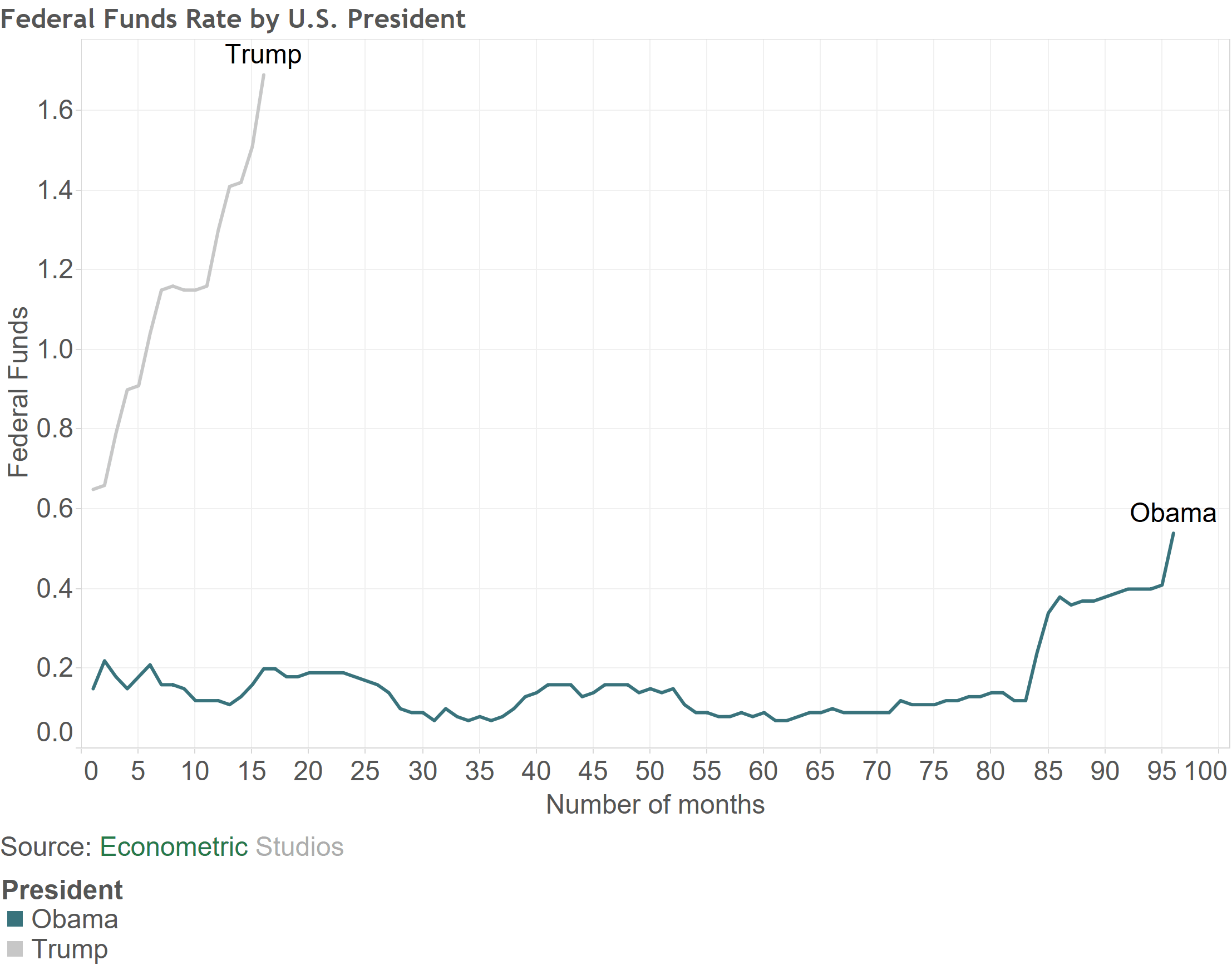
Federal Reserve’s  Open Market Committee, to no one’s surprise,  announced earlier this week that it would be leaving the federal funds target rate at 0.25 percent, exactly where the rate has been since December 2008.  How could anyone look at the following two charts and not come to the same conclusion: the Federal Reserve hates savers? Federal Reserve: What is their goal? Perhaps hates is too strong a word; it’s more like the Federal Reserve is displeased with people that save money in interest bearing assets, akin to the way parents are displeased with a lot of what teenagers do. Recently, the New Yorker published a piece in glowing support of the Federal Reserve’s continued meddling in the market for interest bearing assets. The article had two basic conclusions. First, since savers are a minority – at least those that live off of interest bearing assets – it’s okay to give them the shaft.  The idea is that the billions in forgone income of savers are justified by some theoretical boost to the economy. The second conclusion is summed up as follows: “There’s a myth that monetary policy is a zero-sum game.  But it’s perfectly possible that looser monetary policy could
Read More »


Initial Claims Figures Likely Statistical Noise

May 2, 2013
Trough to Trough Initial Claims

As a backdrop for tomorrow’s big employment report, today’s seasonally adjusted initial claims figures came in at 324K, a decrease of 5.3 percent over the prior week.  Last week’s figure was down 3.7 percent over the April 13th initial claims count. Seasonal initial claims data The seasonally adjusted data can sometimes get the adjustments wrong, but it doesn’t appear to be the case this time, with the non-seasonally adjusted figures (the actual figures) coming in lower than anticipated as well (below). The question is: is there something to the initial claims figures over the prior two weeks, or is it real that the downward trend is still there?  And, as a side note, where are the anti-sequestration advocates?  How can they say the sequestration is hurting the economy with such initial claims figures?  Wouldn’t you like to hear their excuses (although, we all know the excuses will revolve around the noisiness of the initial claims figures)? To answer the question regarding whether the past couple weeks of data are more likely statistical noise or a reversal of the short upward trend (i.e. shifting back towards the prior three year’s downward trend): take a look at this chart once more (below).
Read More »


Does Recent Economic Data Confirm that Sequestration is Good?

April 30, 2013
Sequestration

Over the past few days, a number of economists and other financial professionals have argued that the recent economic data confirms that sequestration is hurting the economy.  Is what they are saying real, or is it just political Krugman-esque gibberish? More than likely, the answer is: it’s all agenda-driven gibberish, rather than unbiased economic analysis.  In sum: the recent economic data do not indicate that sequestration, or more aptly put federal savings (cost reductions), is hurting the economy by some large magnitude.  Rather, recent data suggest that sequestration may be putting a very, very small downward pressure on economic growth (if at all) in the very short term.  And it’s more likely that the recent tax increases are responsible for any stalling growth than it is federal spending.  That’s it. Additionally, the upward boost from reduced deficits and reduced costs of the federal government likely outweigh, by a large amount, any very short-term effects. This article addresses only one component of the government spending advocates argument by looking at the GDP figures in detail. Here are the Commerce Department’s GDP figures from last week. Sequestration and GDP The GDP figures show positive overall GDP growth in all five quarters shown
Read More »


Durable Goods Numbers Near December 2007 High [ANALYSIS]

April 26, 2013
Durable Orders, All, SA 4.24.2013

On the economics side of the information flow absorbed by markets over the past few days, the housing market data came in relatively moderate, with prices indicating some confidence in the future of the demand side. Among this weeks’ big figures are the Census Bureau’s durable goods orders.  Of the entire information released, two are generally considered by market observers as most influential in giving an indication of where the economy is heading: the new durable goods order figure and the new durable goods order less the volatile transportation orders (right or wrong, the reporting is akin to the way the inflation figures are reported excluding the volatile food and energy components). The seasonally adjusted durable goods figures came in below expectations, with the new durable down 5.7 percent over the prior month and the new durable goods orders excluding transportation coming in down 1.4 percent over the prior month. The -5.7 percent figure for new orders puts at about where the figure stood in September 2012.  The $216.276 billion in new orders is up by about $75 billion from its March 2009 low of $141.359 billion and only about $27 billion (13 percent) below the all-time high of $243.721
Read More »


Initial Claims Figures Statistical Noise or Real Growth Problem Story?

April 26, 2013
Initial Claims, 2013

The Department of Labor released their advanced estimates of initial and continuing unemployment insurance claims this morning.  Initial claims came in at a seasonally adjusted rate of 339,000, an increase of 16,000 from the revised 355,000 of the prior week.  Initial claims peaked at 670,000 in the last week of March 2009, and, up until recent months, have been in a downward trend, with the decline from peak to trough standing at about 49% (down 331,000). Moving in the same general direction as initial claims, continuing unemployment insurance came in yesterday at an even 3 million.  Continuing claims peaked in the final week of May 2009 at 6.635 million.  Since then, continuing claims have declined by 3.635 million, or about 55%. The question is: are the initial figures encouraging signs or simply statistical noise in an already bottomed out data series (meaning, claims are now on an upward trajectory)? Looking at the initial claims figures, the current advanced estimate of 339,000 puts the initial claims figure at about 5,000 above its recent bottoming of 334,0000 in the second week of March.  Since that week, four out of the six weeks have posted discouraging signs of labor market improvement, with the
Read More »


GDP, Consumer Sentiment Points to Cruise Control Economy

April 26, 2013
GDP

Today the Commerce Department and the Conference Board gave us the final two economic indicators of this week.  The advanced quarterly GDP figure for the first quarter of 2013 came in at +2.5 percent, representing a decent acceleration from the 0.4 percent of the prior quarter. The details of the GDP data show a private sector continues to grow at a reasonably moderate pace despite growth stunting tax burden increases and small federal spending reductions (any article that calls the federal spending “cuts” as deep simply has an agenda or is simply mimicking prior statements).  Overall, investment private domestic investment grew +12.8 percent on a seasonally adjusted annual rate, while consumption came in at +3.2 percent. In another bright spot of the Commerce Department’s report, aggregate spending by governments declined by 4.1 percent over the prior quarter.  The decline in the cost of government indicates commitment to reducing the costs of the generally unproductive sector (not saying that certain expenditures don’t add value), which, although skewing figures in the short-term, points towards stronger long-term economic growth. On the consumer sentiment side, April’s numbers were relatively positive at 76.4, an increase of 5.7 percent over the prior month.  The increase puts
Read More »


Existing Home Sales at Highest Level Since 2009 [ANALYSIS]

April 22, 2013
number of homes and months supply on the market

The National Association of Realtors (NAR) released their monthly accounting of existing home sales this morning. The report covers three broad areas important to investors and economists: existing homes sales, median and average price of existing home sales, and the inventory of homes for sales.  Here are the figures. The existing home sales figure came in at 4.92 million (annual basis), a decline of 30K or 0.61 percent from the prior month.  The 4.92 million March figures put the first quarter of 2013 as the best quarter since the fourth quarter of 2009, with the year over year growth at 10.3 percent. Perhaps a sign of caution, the first quarter 2013 existing home sales growth figures are all below the fourth quarter of 2012 growth numbers. On the sales price figures, the median price number came in above the prior month, with the median price for March at $190,233, an increase of about 2.8 percent over February. The average selling price for an existing home figure came in at $239,784, an increase of 2.3 percent over the prior month.    In a likely unsurprising trend, the difference between the average price and the median sales price of existing homes continues to
Read More »


What Did We Learn Today From the Initial Claims Figures?

April 18, 2013
continuing claims with the s&p 2012 to current

Initial claims came in at 352K today, an increase of 4K over the prior week.  Since bottoming out in the second week of March, claims have climbed 18K, or about 5.4 percent.  Over the same horizon, claims have ranged from a low of 334K to a high of 388K during Easter week.  Today’s claims figures are below the four week moving average of 361K, although this measure has been increasing since the third week of March.  The four week moving average has increased from 341K in the third week of March to this week’s 361K. On the continuing claims side, today’s figures came in at 3.068 million, representing a decline of 35K over last week.  Continuing claims have generally been performing better than initial claims recently, although claims are up 100K from their bottom in the first week of March. On a four week moving average basis, continuing claims stand at 3.083 million, about 2.25K below the prior week. What have we learned so far this year about the economy from the initial and continuing unemployment insurance claims? The consensus view appears to be that the past month’s increase in initial claims is only a sign that economic conditions are
Read More »


Initial Claims Up 15 Percent Since March 9th Bottom

April 5, 2013
initial claims with the s&p weekly 2000 2013 to current

As a backdrop for today’s big employment report, the Labor Department released its initial and continuing claims figures. Initial claims came in up 28K at 385K, an increase of almost 8%.  Initial claims are now up around 15% since bottom out on March 9th.  On the continuing claims side, the figures are marginally better, with today’s figures putting the continuing claims figure at 3.063 million, a decrease of about a quarter of a percent over the prior week. The market appears to be discounting the initial claims figures, focusing instead on today’s employment report, where the consensus among polled economists stands at an increase of 193K in non-farm employment.  An employment growth figure of 193K would represent moderately low month over month growth. Where do today’s initial claims figures place us on the S&P 500 (INDEXSP:.INX) – Initial Claims continuum? The relationship is presented in the above scatterplot of the S&P 500 (vertical axis) and the weekly initial claims figures (horizontal axis).  The most desirable place to be is in the top left column, where claims are lower than average and theS&P 500 (INDEXSP:.INX) is performing well.  The least desirable place to be is the bottom right quadrant, where the
Read More »